community
What is Post Contact Feedback?
TL;DR
- Post-contact feedback is a way to understand everyday police interactions by asking for brief community input shortly after an encounter.
- It brings visibility to routine moments that rarely show up in reports, but still shape trust, communication, and how the work feels on both sides of an interaction.
Table of Contents
Most days in policing don’t end with a report.
A call gets resolved. A traffic stop wraps up. An officer explains something, answers a few questions, and everyone moves on. Nothing escalates. Nothing feels serious enough to follow up on later.
But those are the moments people remember. The National Institute of Justice (NIJ) found that community perceptions of policing are shaped over time by these routine, non-critical interactions, especially how people are spoken to, treated, and listened to. Not by rare incidents. Not by the moments that make headlines. By the everyday ones that quietly stack up.
The problem is, those interactions usually disappear the second a call is cleared. They don’t show up in reports, dashboards, or reviews, even though they do most of the work in building, or eroding, trust.
That’s the gap post-contact feedback is meant to fill.
What Post-Contact Feedback Is
Post-contact feedback is a simple practice: collecting brief, structured input from community members shortly after a police interaction, while the experience is still fresh.
Because the feedback is tied to a specific encounter, it captures details that are easy to lose over time. Tone. Clarity. Whether someone felt listened to. Small things that rarely become formal data points, but accumulate quickly in real life.
Across agencies using post-contact feedback, this shift is reflected immediately in volume. Departments that previously received two to five pieces of formal feedback in an entire month often begin receiving 30–50 responses per month, sometimes more, once routine interactions become visible.
What Data Becomes Visible with Post Contact Feedback
Once routine interactions start showing up in data, trends begin to emerge naturally.
In KYF deployments, 80–88% of post-contact feedback is positive, often focused on communication, patience, and professionalism, moments that rarely surface anywhere else.
.That context matters. Without it, leadership mostly sees stress points. With it, they can see both where support is needed and where things are working well.
Leaders gain a clearer view of trends across shifts and call types. Officers begin to recognize patterns in their own work that would otherwise stay invisible. Communities have a way to reflect their experience without needing to escalate it.
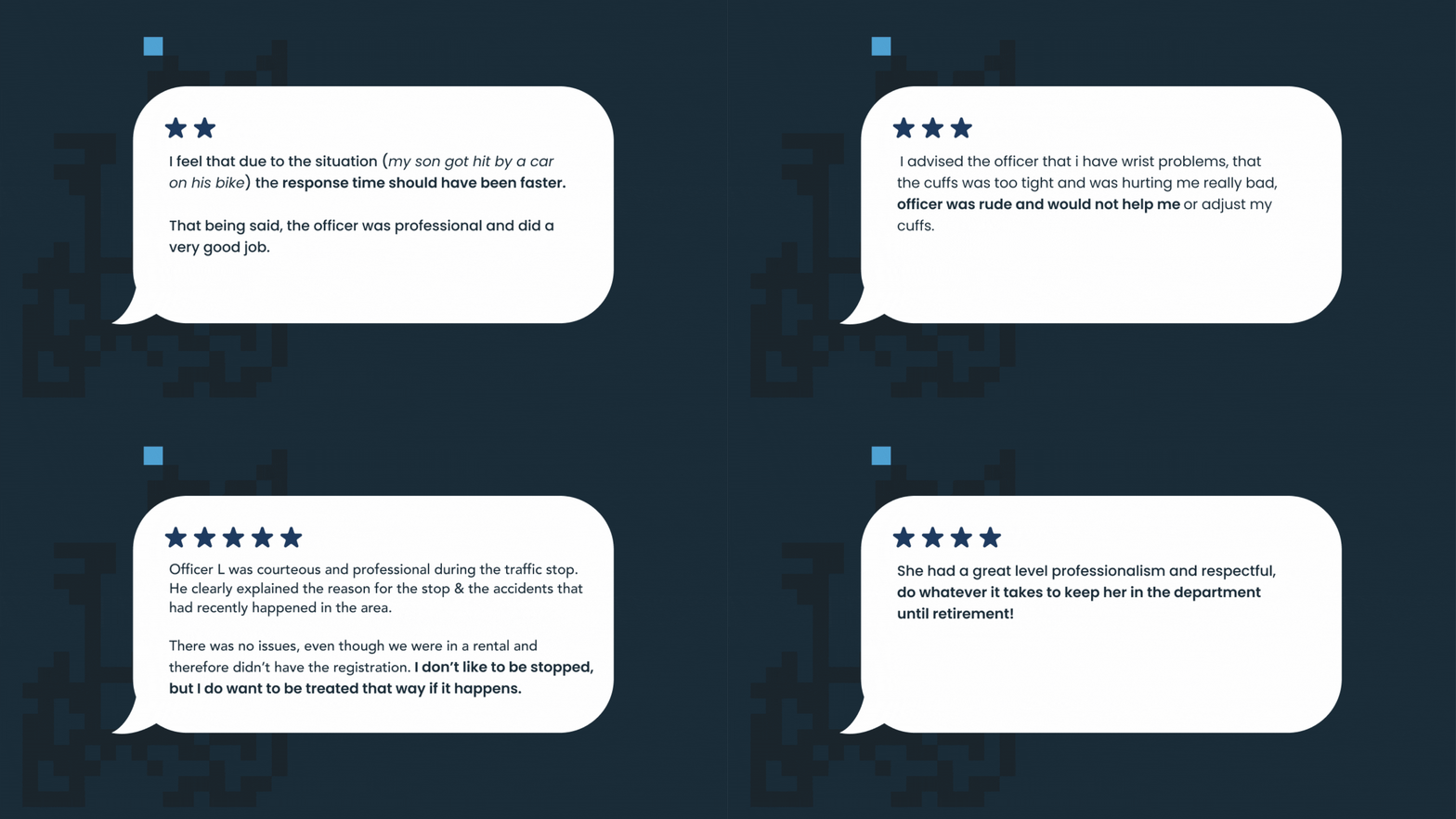
In short, Post Contact Feedback shows what's really happening. Agencies often worry that asking for feedback will uncover only complaints. But the reality is overwhelmingly positive. And if unsatisfactory reviews come across, we’re there at the beginning, capturing the early stages, those subtle signs of disconnect, shifts in tone, or community concerns that can be addressed before they become a problem. Here is an example of what that real mix of feedback can look like.
Why The Timing of Feedback Gathering Matters
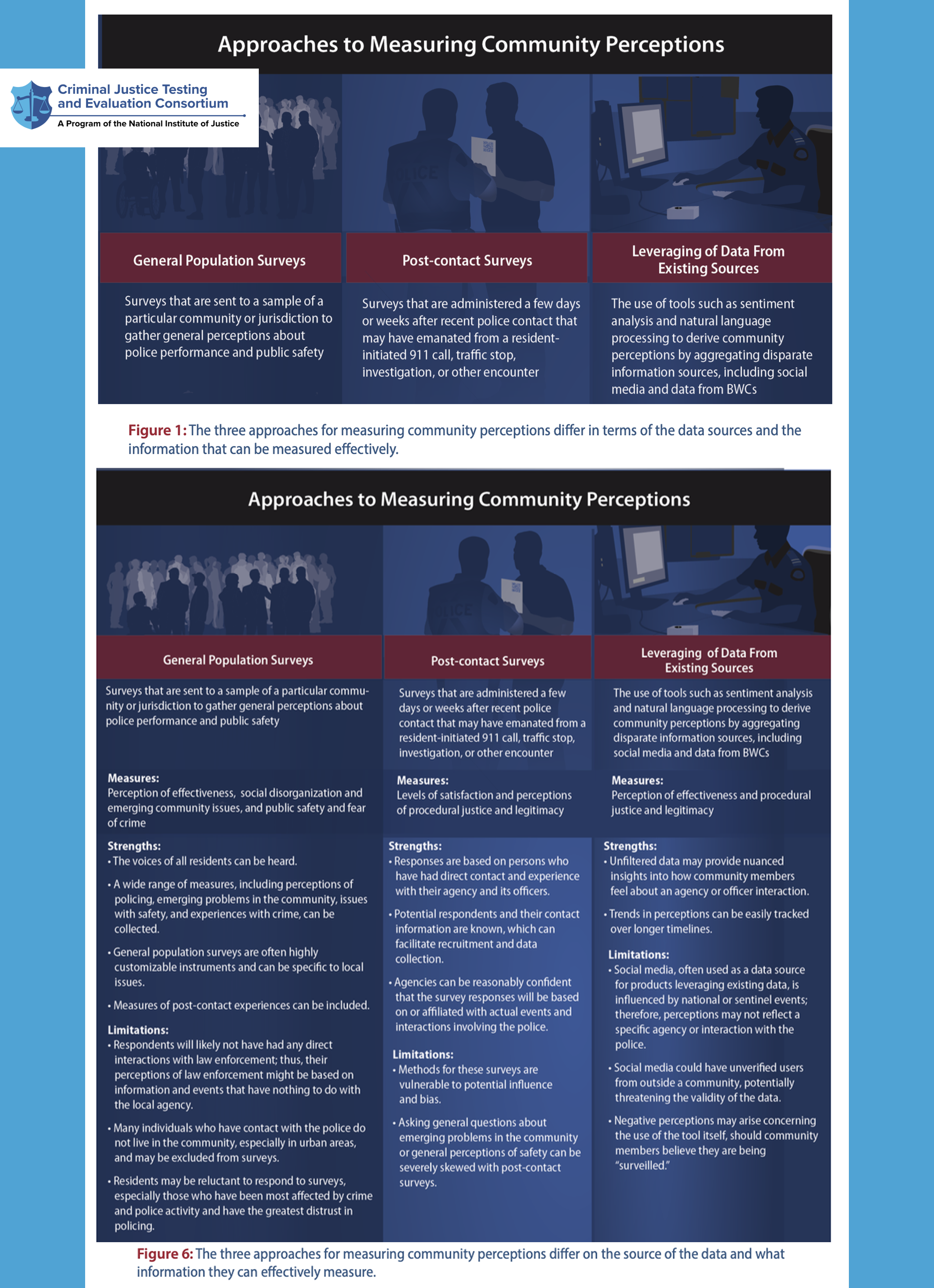
The NIJ outlines three primary ways agencies measure community perceptions: general population surveys, post-contact surveys, and analysis of existing data sources such as body-worn camera footage. Each has a role, but NIJ is clear about the tradeoffs. General surveys provide broad sentiment but often include respondents who never interacted with police. Existing data can offer behavioral insight but lacks the community’s voice.
Post-contact surveys sit in the middle.
They are not meant to represent the entire community, they are meant to accurately reflect specific encounters. When administered shortly after contact, NIJ identifies them as especially effective for measuring procedural justice, communication quality, and satisfaction while the interaction is still clear in memory. That timing is what makes the feedback usable, consistent, and actionable. (Source: National Institute of Justice)
In simpler terms, feedback collected long after an interaction often reflects memory, not the moment itself.
Post-contact feedback stays close to the experience. The question isn’t about policing in general. It’s about that interaction, while the context is still clear.
That proximity is what makes the data consistent. When feedback arrives in days instead of months, patterns surface earlier, and small issues are easier to spot before they harden into something bigger.
What Post Contact Feedback Adds to the Larger Conversation of Policing
Post-contact feedback doesn’t try to define performance or assign meaning on its own. It adds texture.
It brings everyday interactions into view, where trust is built gradually and stress shows up quietly. When those moments become visible, conversations tend to change. Support shows up sooner. Positive work doesn’t disappear. Trends are easier to understand in context.
For agencies trying to understand what’s actually happening day to day, post-contact feedback offers a simple way to see more of the work as it happens.
Not just the rare moments that stand out, but the routine ones that make up most of the job.
Post Contact Feedback: Frequently Asked Questions
1. How does post-contact feedback relate to an Early Intervention System (EIS)?
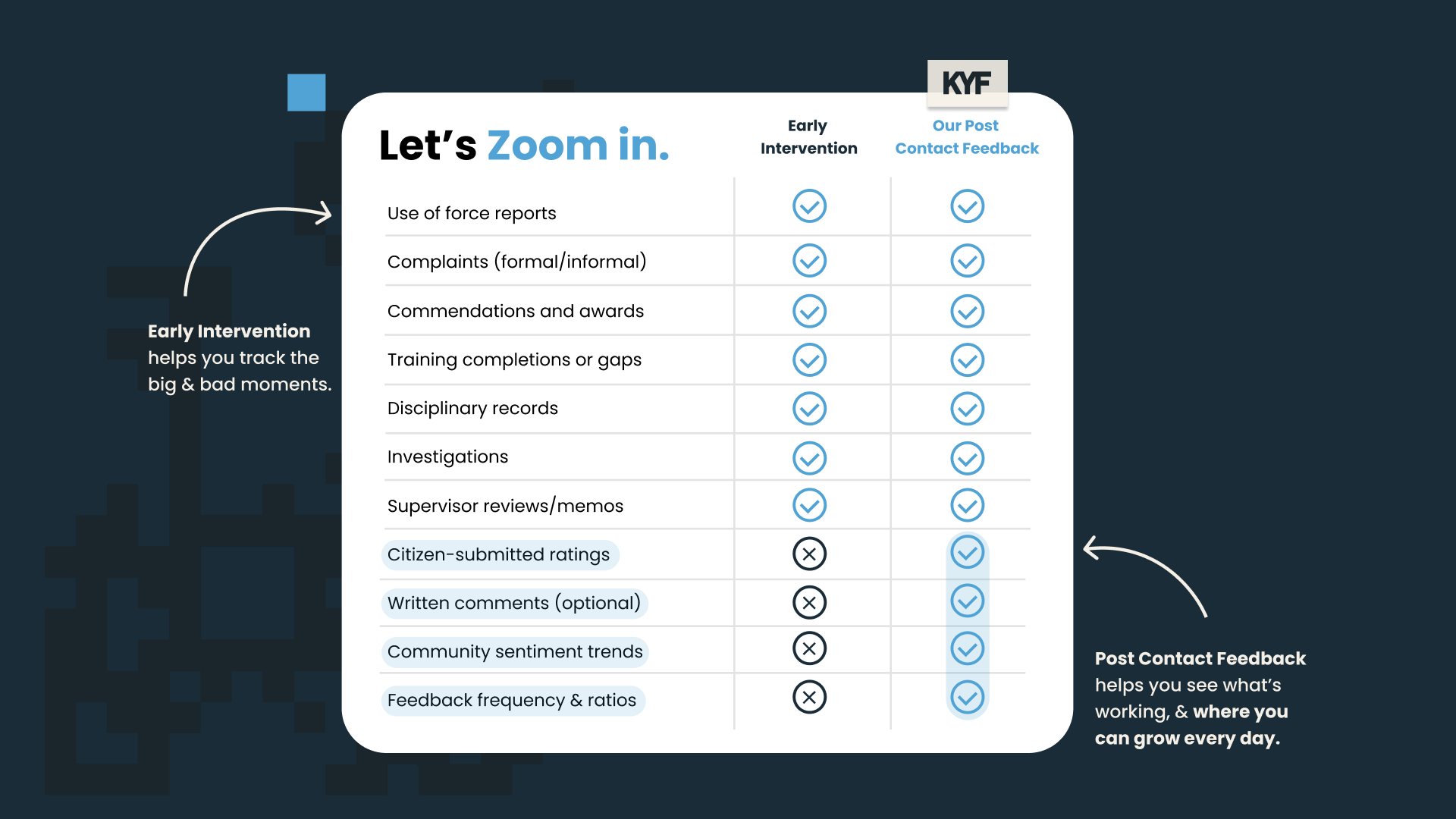
Early Intervention Systems are designed to surface patterns that may need attention, typically based on internal indicators like complaints, use-of-force reports, or policy flags.
Post-contact feedback adds another layer by capturing structured community input from everyday interactions that do not trigger those indicators. Together, they provide a wider view: rare events that require review, alongside routine interactions that shape trust, tone, and early stress.
2. Why add post-contact feedback if an agency already has an EIS?
Most EIS platforms rely on infrequent signals by design. As a result, long stretches of routine work often remain invisible in the data.
Post-contact feedback widens the lens by bringing in high-frequency input from everyday calls, giving leaders more context around patterns that develop well before formal thresholds are met.
3. Does post-contact feedback feed into early intervention workflows?
Yes. When used alongside an EIS, post-contact feedback can inform early intervention conversations by adding context from routine interactions.
Rather than replacing existing indicators, it helps explain what is happening between them.
4. Is Know Your Force an Early Intervention System?
Yes. Know Your Force meets early intervention system requirements and supports early identification, reporting, and supervisory review.
What makes KYF different is that it combines traditional EIS indicators with post-contact community feedback in the same platform, allowing agencies to see both rare events and everyday interactions in one place.
5. Why does combining both matter?
Early intervention works best when patterns are visible early and in context.
By pairing internal indicators with post-contact feedback, agencies gain a clearer picture of officer workload, communication trends, and community experience over time, not just when something escalates.
6. Is post-contact feedback disciplinary?
Post-contact feedback is structured to surface patterns, not to investigate individual incidents. How agencies use the information is guided by their policies and leadership practices, just like any other data source.
7. What kinds of interactions generate post-contact feedback?
Post-contact feedback is typically tied to routine interactions such as calls for service, traffic stops, or community contacts, the moments that make up most of policing but rarely generate formal documentation.