community
How one Police Department Helped Their Officers by Building Trust with Their Community
TL;DR
- Here is an example of the TL;DR section
- Here is an example of the TL;DR section
- Here is an example of the TL;DR section
- Here is an example of the TL;DR section
- Here is an example of the TL;DR section
- Here is an example of the TL;DR section
- Here is an example of the TL;DR section
Table of Contents
In May 2015, President Obama’s Task Force on 21st Century Policing delivered their final report on effectively promoting crime reduction strategies and building public trust in the modern age. The task force was composed of community leaders, academics, and leading experts in law enforcement. Their recommendations were directed at the roughly 18,000 state and local law enforcement agencies in the country and included six foundational pillars for policing and 59 action items. At its core, the report reinforced the notion that “trust between law enforcement agencies and the people they protect…is key to the stability of our communities, the integrity of our criminal justice system, and the safe and effective delivery of policing services.”
The Six Pillars of Policing — 21st Century Policing Task Force
- Building Trust and Legitimacy
- Police and Oversight
- Technology and Social Media
- Community Policing and Crime Reduction
- Officer Training and Education
- Officer Safety and Wellness
Now, almost seven years later, how has this nationwide policing initiative fared within local agencies? The recent high-profile police incidents that have inundated newsfeeds and sparked global protests may lead some to believe it has done little to improve police-community relations. The core principles of policing — not dissimilar from the 21st Century Policing Task Force’s principles — remain as relevant today, however, as they were in 1829 when Sir Robert Peele pronounced that “police are the community, and the community is the police.” Which is why, despite some recent setbacks, police chiefs across the country continue to base their efforts on evidence-based initiatives, like community-oriented policing, to empower their officers and strengthen the communities they serve.
Take, for example, Carthage, Missouri Police Department. In 2020, they began using On-the-Stop survey cards to gather community feedback from each citizen-officer interaction. This community-oriented policing initiative created trust with citizens and boosted officers’ morale.
Dr. Cedric L. Alexander — former Police Chief of Rochester, NY and a member of the Presidential 21st Century Policing Task Force — interviewed Sgt. Jeff Pinnell to understand how Carthage PD uses Know Your Force’s surveys to enhance their COP initiatives and meet the demands of 21st century policing.
Recommended Action Item (Section 2.11.1, 21st Century Policing)
Law enforcement officers carry business cards containing their name, rank, command, and contact information that would enable individuals to offer suggestions or commendations or to file complaints with the appropriate individual, office, or board. These cards would be easily distributed in all encounters.
Change is difficult — community-oriented policing initiatives are no different. “Anything new introduced into police culture is going to be difficult,” said Dr. Alexander. Before implementing Know Your Force, many officers in the department had misgivings about handing out survey cards. Now, the sentiment is clear: officers understand the implicit need to record public feedback. And with an average feedback score of 96 percent, Carthage officers are doing a lot of things right. “It makes them feel better about what they do. I definitely think it’s encouraging to get this feedback from the public,” said Sgt. Pinnell.
On-the-Stop surveys also streamline the community feedback process for police departments. It gives them immediate access to police-community interactions through their data dashboard. “This is not about finding something wrong,” said Dr. Alexander. “This is about acknowledging what your guys are doing right.”
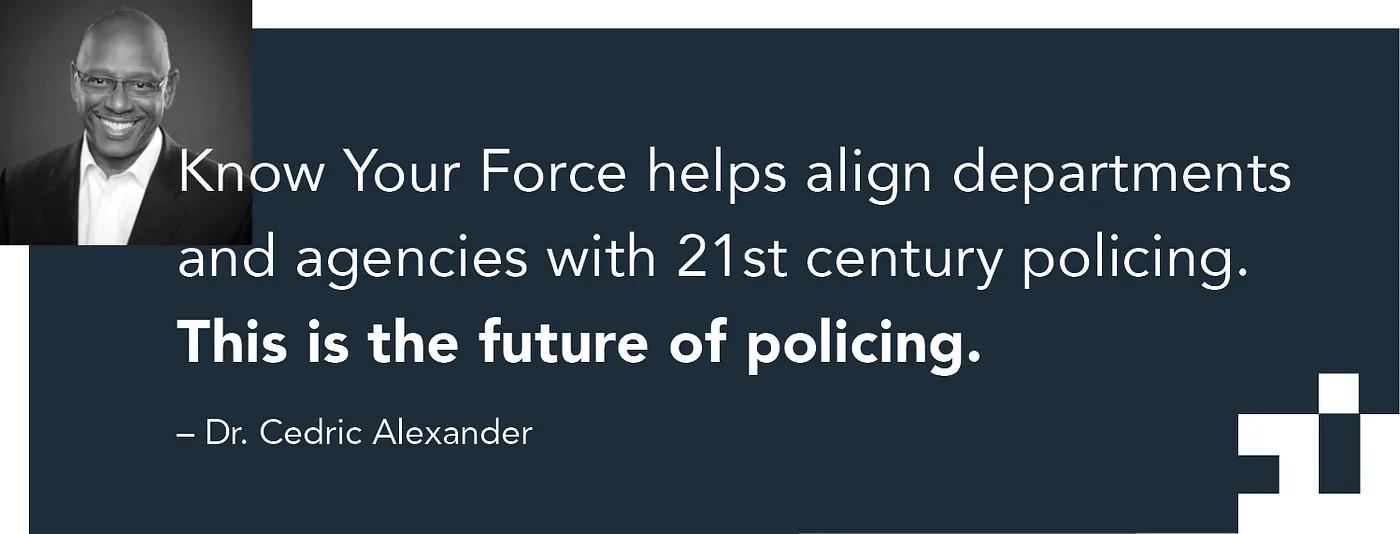
Officers are tasked with creating transparent communication with the community yet are given few additional tools for this often difficult task. Know Your Force gives officers a means to engage with their community on a personal level. It empowers them to drive COP initiatives. With increasing demands from communities and cities, why should departments continue to miss the opportunity to record the positive work their officers are engaged in every day? “Know Your Force helps align departments and agencies with 21st century policing,” said Dr. Alexander. “This is the future of policing.”
At Know Your Force, we believe that police departments like Carthage are not the exception. And though significant work still needs to be done to improve community-police relations, it can not be overstated how a simple, powerful tool like On-the-Stop surveys improves officer well-being and community trust. Research shows time and again the inextricable link between officer and community wellness. Departments must adopt tools that continually engage officers in community-oriented policing. So before departments purchase their next tool, they should ask themselves whether it improves the well-being and safety of their officers and the communities they serve — it doesn’t have to be one or the other.
Learn more about how you can begin to gather community feedback through a simple yet powerful tool here.
Special thanks to Dr. Cedric Alexander